1. They don’t work well with ATS systems
Most companies today use ATS (Applicant Tracking System) software to automatically scan your resume. These systems scan the content on your resume to see if you’re a good fit for the position. Many times, a candidate is qualified, but their resume isn’t optimized for the ATS scans. ATS systems reject nearly 75% of resumes submitted.
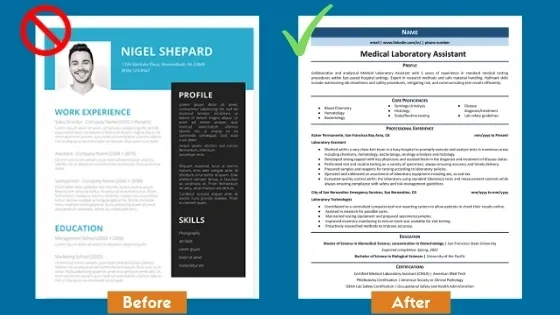
You run the risk of getting rejected by those systems when you use a two-column resume. Use of non-traditional formats confuses many of those programs.
ATS systems don’t appreciate colorful text, creative border designs, columns, or any of those other tricks you might consider for your resume. Instead, the typical ATS wants to see clear, basic resumes filled with text and white space. The fact is you have to give these machines what they want. Otherwise, you will never get your resume past the machine and into human hands.
The following should never be included on a resume as they can make it difficult for an ATS to screen your resume:
- Charts
- Columns
- Graphs
- Tables
- Graphics and infographics
- Images
- Icons
- Illustrations
- Logos
- Fancy fonts
Including any of the items above can make it difficult for an ATS to screen your resume. Creative resumes will do you more harm than good.
2. Hiring managers prefer a standard format
Hiring managers and recruiters can go through hundreds of resumes a week. They spend an average of 6 seconds viewing your resume before deciding to look into it further or reject it.
They are used to a traditional, single column resume that allows them to quickly locate the information they’re looking for. Although a two-column resume may not be difficult to process…we’re talking about a matter of seconds. You have a few seconds to make an impact and using a two-column resume makes your resume just a little more difficult to understand.
3. Formatting gets distorted online
Although the two-column resume may look good on your computer, it could look quite different to someone else opening the file. Many job seekers use a PDF to prevent these distortions, but this isn’t recommended. You should always send your resume in Word unless the employer specifically asks for a PDF.
When you use a two-column resume in Word, you run the risk of the file getting distorted if someone opens your resume in another version of Word or any other processor. Also, computer scans may use OTC (optical character recognition) that will scan your resume linearly–two-column resumes might translate badly in these cases.
4. It won’t help you stand out
A common reason to use a two-column resume is because the applicant wants to stand out or look more modern. These formats can actually make it hard to digitally or visually scan.
Using a two-column resume format also runs the risk of running out of space for all your content. If you spend too much of your two-page real estate on lines, columns, and white space, you won’t be able to fit in all the keywords and information you need to land the interview.