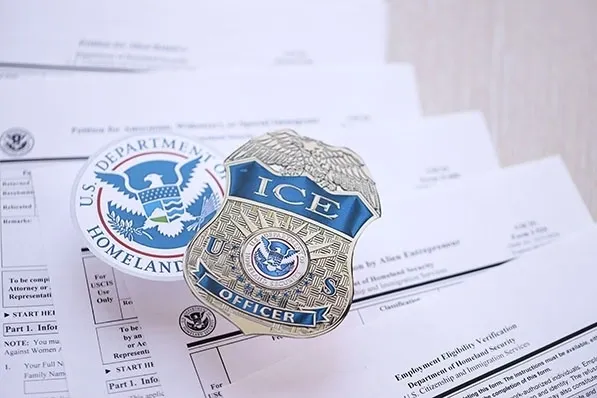
With the increasing activity by U.S. Immigration and Customs Enforcement (ICE), employers should be aware of their responsibilities and how to interact with ICE agents. Generally, ICE agents may inspect a business for workplace enforcement or to conduct inspections of employee I-9 documentation. It is imperative that employers are aware of how to best prepare and respond to these types of situations.
What Information Should Employers Obtain from ICE Agents During a Workplace Interaction?
If ICE agents visit the workplace, employers should immediately contact counsel regarding next steps. ICE agents are required to identify themselves and present proper documentation regarding the proposed search, to enter nonpublic areas of the workplace.
Here are a few steps to follow if ICE agents appear at your place of business:
- Ask the ICE agents to identify themselves with their badge information and a valid subpoena or warrant.
- Document each of the ICE agent’s names, the name of the U.S. attorney assigned to the case, and the type of documentation presented for your records.
- Ask the ICE agents to inform you of the nature and purpose of their visit.
- Ask for a copy of the warrant or subpoena. You do not have to allow ICE agents access to nonpublic areas of the workplace if a proper warrant is not present.
- Once you are handed a warrant and documentation from ICE agents, tell the ICE agent that “It is our company’s policy to call our lawyer and I am doing that now.” Contact your legal counsel immediately so that they can review the documents, ensure that the warrant is valid, and whether they should be present during the search.
- Do not obstruct or interfere with ICE activities or agents. Do not hide employees or help them evade the search. Do not provide any false information, shred documents, or hide documents.
- Create a list of employees present during the raid.
What Parts of the Workplace Can ICE Enter?
ICE is permitted to enter publicly accessible areas of a business without a warrant. However, to enter non-public areas of a business, ICE agents are required to present, upon request, a proper warrant or subpoena. ICE generally operates using either an ICE-issued warrant, or a warrant issued by a state or federal judge in the jurisdiction in which the inspection is occurring. Only a warrant signed by a judge gives ICE agents access to the restricted areas of the workplace. To determine whether a judicial warrant is valid, ensure that the warrant:
- States “U.S. District Court” or a California Superior Court (if in California)
- Is signed by a judge
- Describes the physical place to be searched
- Describes the individuals to be searched or describes the items to be seized if any
- Is dated
- It has been issued within the past 14 calendar days
If the warrant is missing any of these requirements, it is invalid, and employers are permitted to refrain from permitting ICE agents from entering restricted areas of the workplace.
What Can Employers Tell Their Employees to Do During an ICE Inspection?
If ICE agents seek to speak with an employee in the workplace during an investigation, employees do have the right to remain silent and obtain legal counsel.
What Should Employers Do Next?
Employers should have policies in place to ensure a smooth process if ICE agents conduct an inspection at the workplace. Here are some recommendations:
- Indicate which areas of the office are considered public and which areas are nonpublic – since ICE can only enter public areas, if there are areas marked “Employees Only,” those are nonpublic, and ICE cannot enter without a valid warrant.
- Assign an employee to be the designated representative if ICE agents visit the premises to accompany the agent(s) during an inspection. The employee may take notes or videotape the officer. The employee should note any items seized and ask the officer if copies can be made before the originals are taken. If ICE does not agree, you can obtain copies later.
- Ask for a list of items seized during the search. Agents are required to provide you with an inventory of items taken.
- Contact counsel for further assistance on the next steps.
What Differentiates an ICE Inspection from a Notice of Inspection (NOI)?
Federal law requires that employers have an I-9 form on file for each employee within three days of an employee’s hire date to prove that the employee is authorized to work in the U.S. A Form I-9 investigation is initiated when ICE serves the employer with a Notice of Inspection (NOI) – this should not be confused with a warrant, which is addressed above. Employers are required to deliver notice to their employees within 72 hours of receiving the NOI regarding the inspection.
If ICE serves a NOI, immediately contact counsel. Additionally, employers are entitled to up to three business days to produce their employee’s I-9 forms and, if ICE determines that one or more employees are not authorized to work in the United States, employers have up to 10 days to provide valid work authorization for these employees. The employer must notify any employees who the NOI indicates are not authorized to work in the United States of that determination within 72 hours.
Ultimately, when interacting with ICE, employers should immediately contact counsel to determine the next steps and the appropriate course of action.
Contact Grateful Synergies for a free consultation to ensure your compliance with Immigration and Customs Enforcement (ICE) requirements through an I-9 audit.