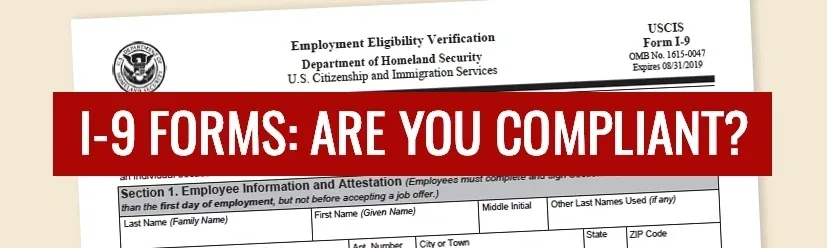
Internal I-9 audits should result in documented changes in practices, not just corrections to the forms, according to Mira Mdivani, an immigration attorney in Overland Park, Kan.
In fact, she cited not understanding the difference between correcting I-9s and correcting practices leading to I-9 violations as one of the top 10 mistakes employers make in handling I-9 forms. She said employers should provide training so the same mistakes aren’t made again and that immigration compliance policies and procedures should be updated after corrections are made.
She listed the other top 10 I-9 mistakes as:
- Allowing untrained staff to administer I-9s.
- Not conducting an internal I-9 audit.
- Having untrained staff engage in the I-9 audit.
- Not supervising new employees filling out Section 1, which causes many Section 1 mistakes.
- Accepting unacceptable documents.
- Accepting fraudulent documents, such as fake lawful permanent resident or Social Security cards.
- Not recording the document title, issuing authority and expiration date or not recording the information correctly.
- Not making copies of I-9s because the employer is relying on U.S. Citizenship and Immigration Services and not on U.S. Immigration and Customs Enforcement (ICE).
- Making corrections without initializing and dating them.
Greg Berk, an attorney with Sheppard Mullin in Orange County, Calif., said employers should double-check that they and employees have filled out every field on the I-9. “The form is inherently confusing, and one should not assume that all fields were completed,” he remarked.
Another frequent error he sees is omitting the Alien Registration Number when the employee is a permanent resident.
Other common mistakes: Employees often do not sign and date Section 1, the employer frequently does not list the date of hire in Section 2 in the certification clause, and the employer often does not sign and date Section 2, he said.
Employers should not accept a restricted Social Security card that says, “Not Valid Without DHS [Department of Homeland Security] Work Authorization,” Berk cautioned.
Reverify
The employer should record the I-9 expiration date for employees working on a work permit (an employment authorization document) or a work visa, but it should not keep I-9s in employees’ HR files, he said.
“The employer must reverify that the foreign national is authorized to work beyond the original expiration date by examining new work authorization documents,” said Kevin Lashus, an attorney with Jackson Lewis in Austin, Texas. “Many organizations do not have a method to track the expiration dates, and therefore fail to reverify.”
“When we discuss the Form I-9 process with clients, we recommend that they review and consider the Form I-9 checklist that ICE publishes as part of its IMAGE [ICE’s Mutual Agreement between Government and Employers] program,” said Robert Groban Jr., an attorney with Berry Appleman & Leiden in New York City. Groban also cautioned employers not to use incorrect or outdated forms.
Timing Errors
The most common mistake Lashus sees is timing errors.
“The most frequent mistake isn’t related to writing information down improperly—although that happens all the time—but is related to the timing of the Form I-9. Section 1 must be completed before close of business (COB) the first day of employ. Section 2 must be completed before the COB the third day after the first day of employ—e.g., if the employee is hired on Monday, Section 2 must be completed before COB Thursday. Exposure arises, when an organization misses the due dates, to the tune of $1,100,” he said.
“Note that this is business days as it relates to the employer, so if the employer is operational over the weekend, the weekend will be counted as business days,” remarked Yova Borovska, an attorney with Buchanan Ingersoll & Rooney in Tampa, Fla. “This cannot be corrected, but there is a five-year statute of limitations after which it can no longer be used against the employer.”
She noted that when a new hire will work remotely and resides far away from the company’s locations, the employer may authorize a local individual it trusts to complete the I-9 verification process. That individual becomes the employer’s agent for I-9 verification purposes; the person might be, for example, a bank representative, notary or lawyer.
“One mistake that some employers will make in this situation is to have the agent physically examine the documents but not complete Section 2. Sometimes the employer will have the agent complete a separate form or document, but the employer will complete Section 2 attesting to having examined the I-9 documents. This is incorrect. The individual who physically examined the documents must be the one signing the attestation under penalty of perjury in Section 2,” she said.
Record Retention Errors
Borovska added that “The requirements for electronic retention are very rigorous and include measures such as reasonable controls, inspection, quality assurance, audit trails, indexing [and] ability to reproduce.”
Purging forms too early sometimes occurs, she noted, in which case the I-9 forms would be treated as missing.
She explained that “the rule is that only terminated employees’ I-9s can be purged three years after hire or one year after termination, whichever is later. Sometimes employers will mistakenly purge forms for active employees, which is inappropriate.”
Borovska added that failure to retain the original form, unless electronically stored and compliant with those requirements, is also a serious error and would be treated either as a failure to produce a Form I-9 or a missing form.